Transforming an ordinary backyard into something visually striking doesn’t always require expensive materials, professional landscaping, or specialized tools. Sometimes, the most unexpected solutions come from reimagining everyday objects in ways they were never originally intended for. That was exactly the case when a woman decided to experiment with a bold and unusual idea: embedding dozens of cheap plastic kitchen spatulas into wet concrete to create a decorative garden border. At first glance, it sounded almost absurd. Neighbors who passed by her home would pause at the sight of what looked like utensils frozen in stone along the edges of her flower beds, unsure whether it was art, a mistake, or some unfinished construction project. The curiosity only grew as the days passed, with more spatulas gradually appearing until nearly fifty of them lined the backyard pathways. People began asking questions, speculating wildly about the purpose of the installation, and even wondering if there was some hidden function they were missing. But behind what seemed like a strange visual experiment was a surprisingly intentional and creative landscaping technique that combined practicality, affordability, and artistic expression in a way few people had considered before.
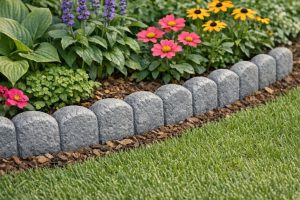
The idea itself is rooted in a simple but clever concept: using repetition and texture to mimic the appearance of natural stone edging without the cost or labor typically required for traditional landscaping materials. Instead of purchasing pre-made decorative borders or hiring professionals to install them, the homeowner used basic construction principles and a bit of imagination to create a unique visual effect. By pouring a strip of wet concrete along the edge of a garden bed and then embedding plastic spatulas into it while it was still pliable, she was able to form a consistent scalloped pattern once the material hardened. The spatulas, partially exposed after curing, created a rhythmic design that resembled carved stone or ornamental edging found in more expensive garden installations. What made the effect particularly interesting was the contrast between the mundane nature of the tools and the structured aesthetic they produced once fixed in place. Kitchen utensils, normally associated with cooking and domestic routine, were transformed into permanent design elements within an outdoor landscape.
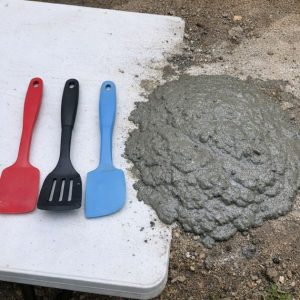
Before the transformation could take place, careful preparation was necessary to ensure the structure would hold properly over time. The process began with clearing and leveling the desired border area, followed by laying down a protective surface to prevent unwanted mess or overflow. Concrete was then mixed to the correct consistency—not too runny, not too dry—so it could be shaped into a stable strip along the garden’s edge. This base needed to be thick enough to support the weight and positioning of the spatulas once inserted, typically around a few inches deep and several inches wide. Once poured, timing became critical. The concrete had to remain wet enough to accept the spatulas but firm enough to hold them in place without collapsing. This delicate balance between flexibility and structure is what allowed the design to take shape successfully. It was not simply a matter of placing objects into cement; it required an understanding of how materials behave during the curing process and how small adjustments could influence the final result.
As each spatula was pressed into the concrete, handle-first, the emerging pattern began to take form. Spacing played an important role in the visual outcome. Even gaps between each utensil ensured consistency, while slight variations in angle or depth created subtle differences that added character to the overall design. The alignment had to be monitored carefully to avoid irregularities that would disrupt the repeating pattern. In many ways, the process resembled crafting rather than construction, blending elements of design thinking with hands-on manual work. To outside observers, it may have appeared unconventional or even confusing, but within the framework of the project, each spatula served a clear purpose. It was not about the object itself, but about the impression it left once integrated into the larger structure. Over time, what began as an experimental idea started to resemble a deliberate decorative feature rather than a random arrangement of household items.
Once the concrete fully cured, the transformation became even more apparent. The once-soft mixture had hardened into a solid, durable border that held the spatulas firmly in place. The neutral gray tone of the concrete provided a subtle backdrop that allowed the shapes of the utensils to stand out without overwhelming the surrounding garden. From a distance, the border appeared structured and intentional, almost like a custom-designed landscape feature. Up close, however, the unusual choice of materials became clear, adding an element of surprise for anyone examining it closely. The contrast between expectation and reality was part of what made the design so engaging. It challenged traditional assumptions about what garden materials should look like and demonstrated how everyday objects could be repurposed into something visually meaningful.
As neighbors continued to notice the evolving installation, curiosity turned into conversation. Some saw it as playful experimentation, a form of backyard creativity that broke away from conventional landscaping norms. Others were simply puzzled, unable to understand why someone would choose spatulas as a building material. But as the project neared completion, the overall effect became harder to dismiss. The border had a rhythm to it, a sense of structure that made it feel intentional rather than improvised. Even those who were initially skeptical began to appreciate the originality behind the design. It became a local talking point, not because it followed established design rules, but because it openly challenged them. In a neighborhood where most gardens followed familiar patterns of stone, wood, or metal edging, this installation stood out precisely because it did something different.
Beyond its visual impact, the project also highlighted a broader shift in how people approach DIY creativity and home improvement. Instead of relying solely on store-bought materials or standardized designs, more individuals are beginning to experiment with repurposing everyday objects in ways that reduce cost while increasing personal expression. The spatula border is a clear example of this mindset. It demonstrates that creativity often lies not in what materials are used, but in how they are combined and reimagined. A kitchen utensil, normally associated with cooking and routine household tasks, can become part of a permanent outdoor structure when placed in a new context. That shift in perspective is what transforms ordinary projects into memorable ones.
Over time, the garden border continued to age naturally, blending further into the surrounding environment. Plants grew alongside it, softening its edges and integrating it into the landscape. What once looked unusual or experimental gradually became a familiar part of the backyard’s identity. Visitors who once questioned its purpose began to accept it as a defining feature of the space. And while the spatulas themselves remained visible, they no longer seemed out of place. Instead, they became part of a larger story about resourcefulness, creativity, and the willingness to experiment without fear of imperfection.
In the end, the project was never really about spatulas or concrete. It was about rethinking the boundaries of design and discovering how ordinary materials can take on extraordinary roles when viewed differently. What began as a strange backyard experiment ended as a functional piece of landscape art that continues to spark curiosity and conversation. And perhaps that is its greatest success—not just that it exists, but that it invites people to look again at the objects around them and ask what else might be possible.