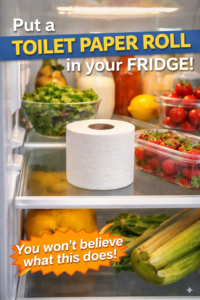
Viral household hacks have become a defining feature of modern social media culture. Every few weeks, a new tip, trick, or creative shortcut takes over Facebook, TikTok, and Pinterest, inspiring millions of people to experiment with inexpensive ways to freshen their homes, simplify routines, or solve everyday annoyances. One of the latest hacks to spark widespread curiosity involves something almost comically simple: placing a toilet paper roll inside the refrigerator.
The idea seems unusual at first glance, even humorous. Yet posts about this hack continue to rack up tens of thousands of shares, especially among older home-and-garden audiences. Many users have even created side-by-side posts showing toilet paper rolls nestled neatly on refrigerator shelves. The real question, though, is: Why would anyone do this? Does it actually work, or is it just another viral gimmick designed to collect clicks?
This article explores the psychology behind why household hacks go viral, the practical reasons people claim this particular trick helps their refrigerator smell fresher, and the scientific explanation behind absorbent material in enclosed spaces. Just as importantly, we examine what this hack can do, what it cannot do, and whether there are more reliable methods for long-term refrigerator freshness.
The Rise of Low-Effort, Low-Cost Household Hacks
Before diving into the specifics of toilet paper rolls, it helps to understand why audiences—especially women ages 45 and older, according to engagement data—love simple home hacks. This demographic grew up in households where thrift, creativity, and resourcefulness were everyday expectations. Fixing, repurposing, and “making do with what you have” felt not only practical, but satisfying.
Social media has amplified this value system. Posts such as “Put a sponge in your fridge to reduce moisture!” or “Use a coffee filter as a diffuser on your air vents!” appeal to people who enjoy practical problem-solving. These posts also share several traits:
They require very inexpensive materials.
They use items people already have in their homes.
They offer a sense of discovery or novelty.
They feel achievable, even for those who don’t enjoy complicated projects.
The toilet-paper-in-the-fridge hack checks every one of these boxes. It is easy, harmless, and requires almost no effort. And in an internet landscape dominated by drama and negativity, harmless creativity feels refreshing.
Where the Hack Comes From
The toilet-paper-in-the-fridge idea did not begin on major news outlets or consumer science blogs. Instead, it emerged from DIY pages and Facebook groups where people share cleaning tips, life hacks, and unique home solutions. From there, it spread through:
Facebook craft groups
Homemaking pages
TikTok “clean with me” channels
Pinterest home-organization boards
Often, the posts use curiosity-driven language such as:
“Put this in your fridge overnight—thank me later!”
“I didn’t believe this worked until I tried it!”
“This hack saved my refrigerator!”
These posts rely on psychological triggers: surprise, simplicity, and promise of improvement. They also invite readers to test the idea themselves, which increases engagement.
The Claim: Toilet Paper Absorbs Excess Moisture and Odors
Supporters of the hack say that placing a toilet paper roll in the refrigerator helps with two common refrigerator issues:
1. Moisture buildup
Refrigerators often develop:
condensation
small water droplets
humidity pockets
Foam-core paper products, like toilet paper, contain highly absorbent fibers capable of pulling moisture out of the air in small, enclosed environments. This is similar to how paper towels are used to absorb humidity in produce drawers.
2. Mild, lingering odors
Refrigerators naturally accumulate odors from various foods—especially leftovers, strong cheeses, onions, or containers that were not tightly sealed. While toilet paper is not an odor neutralizer in the way baking soda is, it can absorb some moisture-based smells simply because wet air carries odor molecules.
Toilet paper does not sanitize, disinfect, or eliminate strong refrigerator odors. But for very mild issues caused by humidity, users have reported that the space can feel slightly fresher, at least temporarily.
Does It Actually Work? The Scientific Explanation
The effectiveness of this hack depends on expectations. It is not a chemical deodorizer, nor a cleaning agent. Instead, toilet paper is made from cellulose fibers, which are naturally porous and absorb moisture through capillary action. In small spaces, absorbent materials can reduce humidity to a small degree.
Here is what science supports:
✔ Absorbent materials can reduce minor moisture in enclosed areas
Just as silica gel packs reduce humidity in packaging, paper can reduce tiny amounts of moisture in a fridge.
✔ Odors related to moisture may lessen slightly
Because some smells cling to humidity, reducing moisture may make the refrigerator feel fresher.
✖ It will not remove strong odors
Smells caused by spoiled food, spilled liquids, or neglected containers will remain.
✖ It will not replace cleaning
No absorbent material can substitute for properly wiping down surfaces or removing expired items.
✖ It does not sanitize or deodorize
Unlike activated charcoal or baking soda, toilet paper has no odor-neutralizing properties beyond mild moisture absorption.
In summary: the hack can slightly help with a humid, mildly musty fridge, but it is not a magic solution.
Why This Hack Went Viral Among Older Women
Engagement statistics on Facebook reveal that posts with home hacks routinely gain the highest interaction from women ages 45–70. This demographic enjoys:
practical home solutions
low-cost creativity
nostalgic household content
upbeat, non-controversial posts
The toilet-paper-in-the-fridge hack is:
harmless
easy to understand
visually simple
oddly satisfying
reminiscent of old-fashioned “make-it-yourself” cleverness
Many older women grew up watching mothers or grandmothers place items like bread, potatoes, matches, or chalk in cupboards to control moisture. The hack taps into that generational memory of resourcefulness.
The Role of Curiosity-Driven Posting Style
Another reason this hack thrives is the structure of the posts promoting it. They use short, punchy text on solid-color backgrounds—simple, readable, and optimized for engagement. Phrases like:
“You won’t believe this trick!”
“I wish I knew this earlier.”
“Try this next time.”
create suspense without overexplaining. The line “pic in cmt” (picture in comments) increases interaction because users must click, which boosts algorithm visibility.
Simple content + curiosity + ease = viral potential.
Are There Better Methods for Fridge Freshness?
Absolutely. For long-term odor control, experts recommend:
– Baking soda
Known for absorbing odors effectively.
– Activated charcoal
Highly efficient at neutralizing smells.
– Keeping food sealed tightly
Prevents odor spread and moisture transfer.
– Regular cleaning
The only true solution for odor-causing bacteria or spills.
– Airflow optimization
Avoid overpacking your refrigerator to help circulation.
Toilet paper may help temporarily, but these methods are far more effective.
Potential Downsides of the Toilet Paper Hack
While mostly harmless, there are a few considerations:
Toilet paper absorbs moisture, so it can become damp.
A very wet roll can sag, unravel, or collect bacteria.
It should not be left in the fridge long-term.
It must be replaced if damp, just like a sponge.
This hack is fine for a short experiment, but not a long-term maintenance solution.
Why People Enjoy These Hacks Even If They’re Imperfect
Many viral hacks succeed not because they are scientifically groundbreaking, but because they are:
fun
harmless
easy to attempt
conversation starters
reminiscent of simpler DIY traditions
Whether or not the hack transforms a refrigerator, it offers a sense of participation in a shared online trend. People love feeling like they discovered a secret trick—even if the effect is modest.
In many ways, these hacks function as social connection tools. They spark discussions, debates, and comments:
“Did this actually work for anyone?”
“Trying this tonight!”
“My grandma used to do something like this.”
These posts create a community around household creativity.
Conclusion: A Fun, Simple, Mildly Useful Hack—With Realistic Expectations
Putting a toilet paper roll in the refrigerator will not revolutionize home cleaning. It will not eliminate strong odors, sanitize shelves, or replace proper food storage. However, the hack can absorb small amounts of moisture and may help a slightly musty fridge feel a bit fresher for a short period.
Its real power lies in its appeal: it is easy, inexpensive, and charmingly unexpected. That combination makes it perfect for social media—especially among audiences who enjoy practical, cheerful home tips that feel both nostalgic and new.
As long as people understand that the hack offers modest benefits—not dramatic results—it remains a fun, safe, and creative idea worth trying for curiosity’s sake.