There are certain things we never truly forget.
The smell of fresh laundry dried in the summer sun. The sound of a screen door closing behind children running barefoot through the yard. The feeling of falling asleep beneath a handmade quilt stitched with care and patience.
For many women who grew up in the 1960s and 1970s, quilts were not decorations bought from a store. They were stories sewn together. They were winter warmth. They were gifts from mothers, grandmothers, and aunts who believed that fabric scraps should never go to waste.
And sometimes, those quilts end up folded quietly in the back of a closet.
Not because they are no longer loved. But because life changes. Homes get redecorated. Styles shift. Storage fills up. What once lived proudly on a bed slowly gets tucked away “for later.”
Until one day, you find it again.
That moment — pulling a soft, slightly faded patchwork quilt from a closet shelf — can stop you in your tracks.
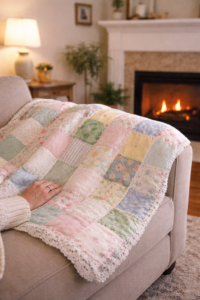
The pastel squares. The tiny floral prints. The careful stitching. The lace trim along the edge. Suddenly, you are not just holding fabric. You are holding memory.
And sometimes, all it takes is placing that quilt back into your living room to change the entire feel of your home.
Why Quilts From the 60s and 70s Are So Special
During the 60s and 70s, patchwork quilts were everywhere in American homes. They were handmade from old dresses, flour sacks, baby blankets, worn shirts, and leftover fabric from sewing projects.
Nothing was wasted.
Women gathered at kitchen tables with scissors, pins, and thread. They talked about their children. They shared recipes. They laughed. And square by square, something beautiful came together.
Every patch told a story.
Maybe one square came from a Sunday church dress. Maybe another came from curtains in the first family home. Maybe a faded blue piece once belonged to a husband’s favorite shirt.
These quilts were layered with history long before anyone called it “vintage.”
Today, when you pull one from a closet, you are not just rediscovering an old blanket. You are rediscovering a piece of your life.
Turning a Closet Find Into Living Room Warmth
When she found her old quilt again, she did not plan anything dramatic. She simply unfolded it.
At first, she thought about washing it and storing it properly. But instead, she laid it across the back of her sofa.
Instantly, the room changed.
The neutral couch felt softer. The beige walls felt warmer. The space that once felt plain suddenly felt personal.
That is the power of textile warmth.
Modern homes often lean toward minimalism — clean lines, solid colors, simple décor. While beautiful, they can sometimes feel a little cold.
A patchwork quilt adds depth. It adds texture. It adds story.
And unlike a brand-new throw from a store, this one carries emotion.
The Emotional Impact of Fabric and Memory
There is research suggesting that touch and memory are deeply connected. When we run our hands over familiar textures, our brains light up with associations from the past.
That is why holding an old quilt can bring tears to your eyes.
It is not just nostalgia. It is sensory memory.
The softness reminds you of childhood naps. The weight reminds you of snowy evenings. The faded colors remind you of a time when life moved more slowly.
When she draped that quilt over her couch and sat beside it, she felt something shift.
The house did not just look warmer.
It felt warmer.
Simple Ways to Style an Old Quilt in a Living Room
If you have a quilt tucked away, there are beautiful ways to bring it back into daily life:
1. Sofa Throw
Fold it neatly and drape it across the back or arm of your couch. Let a bit of lace or pattern show.
2. Accent Chair Cover
Place it over a reading chair to create a cozy corner.
3. Coffee Table Layer
Fold it and lay it partially over a wooden trunk-style coffee table for layered texture.
4. Wall Display
If the quilt is too delicate for daily use, hang it as wall art using a simple rod.
5. Bed Layering
Use it at the foot of the bed as a decorative topper.
Each option brings warmth without overwhelming the room.
Why Older Women Connect So Deeply With This
For women now in their 60s, 70s, or beyond, quilts are not decorative trends.
They are memory holders.
They represent a time when things were handmade instead of mass-produced. When evenings were spent sewing instead of scrolling. When homes were built slowly, piece by piece.
Seeing a quilt brought back into use feels like reclaiming something important.
It says: this still matters.
And in a world that moves quickly, that reminder is powerful.
The Beauty of Imperfection
Vintage quilts often show signs of wear.
Threads loosen. Colors fade. Edges soften.
But those imperfections are not flaws. They are evidence of life.
They show that the quilt was used, loved, washed, folded, and unfolded countless times.
That kind of authenticity cannot be purchased.
In fact, many interior designers today intentionally seek out “worn” textiles because they bring depth to a space.
But for someone who grew up with quilts, that depth is not design strategy.
It is simply home.
When Tears Come Unexpectedly
She did not expect to cry when she unfolded the quilt.
But as she smoothed it across the sofa and stepped back, she felt a rush of memory.
The house she grew up in. The sound of her mother’s sewing machine. The way the quilt felt on her bed as a little girl.
It was not sadness.
It was gratitude.
Gratitude for having something that lasted.
Gratitude for hands that stitched patiently years ago.
Gratitude for the quiet resilience of fabric that survived decades.
Those are the “happy tears” so many women understand without explanation.
A Warmer Living Room Without Buying Anything
One of the most surprising things about adding a vintage quilt to a living room is how little effort it takes.
You do not need new furniture.
You do not need new paint.
You do not need a full renovation.
Sometimes, you simply need to reintroduce something meaningful.
In doing so, you add warmth that cannot be replicated by new décor alone.
Passing Down More Than Fabric
Quilts are often passed from generation to generation.
When grandchildren visit and notice the quilt draped over the couch, conversations begin.
“Where did this come from?”
“Did you make this?”
“Was this yours when you were little?”
And suddenly, stories are told again.
That is how memory stays alive.
By using the quilt instead of storing it, you invite those stories back into daily life.
The Comfort of Familiar Patterns
Floral prints, gingham squares, pastel patches — these patterns feel familiar because they were once everywhere.
Bringing them back into your home does not mean stepping backward in time.
It means honoring where you came from.
It means recognizing that beauty does not expire.
And it means allowing yourself to surround your present with reminders of your past.
A Gentle Lesson in Letting Go of Trends
Design trends change every few years.
What was popular in the 70s faded in the 80s. What was stylish in the 90s feels dated today.
But quilts remain.
They move through decades without losing their heart.
In a way, they teach us something important: lasting comfort is more valuable than temporary style.
When she placed her quilt in the living room, she was not chasing trends.
She was choosing comfort.
And comfort, especially later in life, matters deeply.
Reclaiming the Cozy Feeling
Many women describe a quiet shift that happens when they bring old quilts back into use.
The room feels less like a showroom and more like a sanctuary.
The couch invites you to sit longer. The fireplace feels warmer. The lamp light glows softer against patterned fabric.
It is subtle, but unmistakable.
Cozy is not something you can buy.
It is something you create.
What If Your Quilt Is Delicate?
If your quilt is very old or fragile, you can still incorporate it gently:
Use it only when guests visit
Display it folded neatly in a basket
Place it across a spare bed
Photograph it and frame the image
The goal is not heavy use. The goal is presence.
Let it be seen.
Let it breathe.
Let it remind you of where you have been.
Why This Idea Spreads So Easily on Facebook
When older women see a familiar quilt in a cozy living room setting, something clicks immediately.
They remember their own.
They wonder where theirs is stored.
They imagine unfolding it again.
That curiosity draws them in.
Not because the idea is complicated.
But because it feels personal.
It speaks directly to memory.
The Quiet Joy of Reintroducing the Past
There is something powerful about not letting meaningful items disappear into storage.
Bringing a quilt back into your living space says that your past is not something to hide.
It is something to honor.
Every home holds pieces of history.
Sometimes they just need to be unfolded.
A Final Thought
If you grew up in the 60s or 70s, chances are there is a quilt somewhere in your home that carries your story.
Maybe it is folded in a cedar chest. Maybe it sits on a high closet shelf. Maybe you have not touched it in years.
Take it down.
Unfold it slowly.
Lay it across your sofa.
Sit beside it for a moment.
You may find that your living room feels warmer.
And you may find that your heart does too.