While cleaning out my old house, I found this. Guess what—90% of people today have no idea what it is. It wasn’t hidden in a safe or wrapped carefully in cloth. It was sitting quietly in the back of a cabinet, pushed behind chipped mugs and yellowed instruction manuals, its surface dulled by time but still unmistakably solid. The moment I picked it up, something stirred—an image, a smell, a sound that didn’t belong to the present.
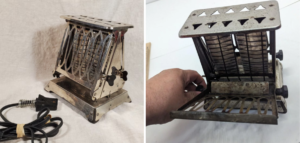
It was a stovetop toaster.
Not the kind that hums on a countertop and pops bread into the air when it’s done. This was a heavy, metal contraption with wire racks and a handle that had been warmed by countless mornings. It was designed to sit directly on a burner, turning simple slices of bread into toast through heat, patience, and attention. To anyone born into the age of automatic appliances, it looks confusing, even impractical. But once upon a time, it was a small luxury, a symbol of progress, and a central part of the daily rhythm of family life.
Holding it in my hands felt like holding a piece of someone else’s morning.
A Kitchen That Was the Heart of the Home
Imagine a crisp Saturday morning in the 1950s. The house is still quiet, but the kitchen is already awake. Sunlight slips through thin curtains, catching dust motes in the air. The radio hums softly in the background—news, maybe music, maybe a familiar voice announcing the day. Coffee percolates slowly on the stove, filling the room with a rich, comforting aroma.
At the center of it all is the stovetop.
Someone stands there, sleeves rolled up, hair still slightly tousled from sleep. In their hands is that shiny metal device—the stovetop toaster. Bread is placed carefully on its wire racks, one slice at a time. The toaster is positioned just right over the flame. There is no timer, no button, no automatic shutoff. The only tools are experience and attention.
Every few seconds, the bread is checked. The slices are turned by hand, the color judged by eye alone. Too soon, and it’s pale and soft. Too late, and it’s burnt. Perfect toast exists in a narrow window, and hitting it feels like a small victory.
This wasn’t just breakfast preparation. It was a ritual.
When Toast Required Skill
Unlike modern pop-up toasters, the stovetop toaster demanded presence. You couldn’t walk away. You couldn’t multitask too much. You had to stand there and watch the bread transform, listening for subtle changes, watching the surface darken, smelling the shift from raw bread to something warm and inviting.
There was tension in it, even in something so simple.
Would the bread burn? Would one side cook faster than the other? Did the flame need adjusting? These small decisions mattered. They made the act of toasting bread feel interactive, personal, and surprisingly intimate.
When the toast was finally done, it was placed on a plate—often warmed by proximity to the stove. Butter was spread immediately, melting into the surface. Sometimes jam followed. Sometimes it was eaten plain, appreciated for what it was.
That first bite, crisp on the outside and soft inside, felt earned.
A Luxury Disguised as Simplicity
To modern eyes, a stovetop toaster looks primitive. But in its time, it was anything but. It represented innovation—an attempt to make everyday life more enjoyable, more efficient, more refined.
Electric pop-up toasters existed, but they weren’t universal. Many homes still relied on gas or wood stoves, and not every household could afford the newest electric gadgets. A stovetop toaster bridged that gap. It allowed families to enjoy evenly toasted bread without needing electricity or expensive appliances.
It was functional, yes—but also aspirational.
Owning one meant caring about the small pleasures of life. It meant breakfast mattered. It meant taking a moment to make something ordinary feel special.
Minimalism Before It Had a Name
The stovetop toaster was a lesson in minimalism long before the word became trendy. It had one purpose and did it well. No plastic. No circuitry. No hidden mechanisms. Just metal, wire, and heat.
It didn’t try to anticipate your needs. It didn’t automate the experience. It invited you to participate.
There’s something almost radical about that now.
Today’s appliances are designed to remove us from the process. Press a button, walk away, wait for a beep. Efficiency is prized above all else. The stovetop toaster asked for your time—and rewarded you with a sense of involvement.
A Tool That Taught Patience
Using a stovetop toaster required patience, a skill that has quietly faded from many daily routines. You couldn’t rush it. If you tried, you paid the price in burnt bread or uneven results.
Children learned by watching. They learned how long to wait, how to judge doneness, how to turn the bread just right. These weren’t formal lessons, but they stuck. They taught attention to detail, care, and respect for the process.
In that sense, the stovetop toaster was educational. It was one of those household objects that quietly shaped behavior and habits without anyone realizing it.
The Social Side of Breakfast
Breakfast back then wasn’t something eaten alone, hunched over a phone or grabbed on the way out the door. It was communal. People gathered around the table. Conversations happened. Plans were discussed. Arguments were settled. Laughter happened between bites.
The stovetop toaster often sat at the center of that scene, its use spread out over time. Toast was made in batches. Someone always had to get up for another slice. It created movement, interaction, shared responsibility.
There was no “everyone serve yourself at once.” The process itself encouraged togetherness.
Objects With Emotional Weight
One of the most striking things about finding that toaster was how emotional it felt. It wasn’t just an object. It carried memory.
Kitchen gadgets in the mid-20th century weren’t disposable. They were built to last. They were cleaned, repaired, and passed down. Each scratch and dent told a story—of hurried mornings, of guests visiting, of children learning to cook, of hands that no longer exist.
These objects had emotional value because they were present for life as it happened. They didn’t change every few years. They stayed, quietly witnessing the passage of time.
Why So Many People Don’t Recognize It Today
Ask someone under 30 what a stovetop toaster is, and most will guess incorrectly. Some think it’s a trivet. Others assume it’s a strange grill or a piece of industrial equipment. The idea that you would toast bread on a stove feels foreign now.
That’s not because people are less capable. It’s because life has shifted.
We live in a world where convenience is built in, where technology anticipates our needs, where speed is prioritized. The idea of standing at a stove just to toast bread feels inefficient—even unnecessary.
And yet, something has been lost in that transition.
When Tools Asked for Attention
The stovetop toaster demanded engagement. You couldn’t ignore it. You had to be present. That presence anchored you in the moment, even if only for a few minutes.
Today, so many tasks are designed to happen in the background. Food cooks while we scroll. Appliances work while we multitask. Moments slip by unnoticed.
The toaster on the stove didn’t allow that. It asked you to slow down, even briefly, and focus.
A Reflection of Its Time
In the broader context of the 20th century, kitchen gadgets like the stovetop toaster symbolized a particular moment in history—a time of ingenuity, optimism, and gradual progress.
People were rebuilding after hardship. They valued durability. They appreciated small comforts. Domestic life was not seen as trivial; it was central. The home was a place of pride, and the tools within it reflected that.
These gadgets were more than conveniences. They were expressions of care—for family, for routine, for the idea that everyday life could be made a little better.
The Beauty of Imperfection
Toast from a stovetop toaster wasn’t always uniform. Sometimes one side was darker. Sometimes a corner burned slightly. But that imperfection was part of the charm.
It reminded you that a human had been involved.
There’s a quiet satisfaction in knowing something wasn’t produced by a machine alone, but by attention and judgment. It made the food feel personal, even when it was just bread.
What We Lose When Everything Is Automatic
Finding that old toaster made me think about how many small skills have disappeared. Not because they’re useless, but because we no longer need them.
We don’t judge heat by feel. We don’t watch for color changes. We don’t listen for subtle cues. Machines do it for us.
In gaining convenience, we’ve lost a certain intimacy with our tools and tasks. We’ve traded involvement for speed.
Why This Object Still Matters
The stovetop toaster matters not because we should all go back to using one, but because it represents a mindset.
It represents a time when everyday actions were intentional, when tools invited participation, when patience was part of the process. It reminds us that life doesn’t always need to be optimized to be meaningful.
Sometimes, the value lies in the doing.
A Quiet Reminder From the Past
As I put the toaster back on the counter, I didn’t feel the urge to throw it away. I cleaned it. I held it a little longer. I imagined the hands that had used it before me, the mornings it had been part of, the simple joy it had helped create.
That small metal device carried decades of human presence. And in a strange way, it made my modern kitchen feel more connected to the past.
Final Thoughts
So while cleaning out my old house, I found this—and realized why so many people don’t recognize it anymore. The stovetop toaster isn’t just a forgotten gadget. It’s a reminder of a slower rhythm, a more tactile relationship with everyday life, and a time when even making toast required care.
It shows us that objects don’t need to be smart to be meaningful. They need to be used, loved, and woven into the fabric of daily life.
And maybe that’s why, decades later, finding it felt like discovering more than a tool. It felt like uncovering a story—one that still has something to teach us, if we’re willing to look closely enough.



