There are people who live through history, and then there are those who hold it—carefully, deliberately, refusing to let it be bent, erased, or simplified. When such a person leaves the world, the silence they leave behind feels heavier than grief alone. It feels like the closing of a chapter that many assumed would never end.
That is what the passing of Betty Reid Soskin has felt like for so many.
At 104 years old, she was not only the oldest living ranger of the National Park Service, but one of the most morally grounded voices ever to wear its uniform. Her death on December 21, 2025, did not simply mark the loss of a remarkable individual. It marked the departure of a living bridge—between centuries, between movements, between the history written down and the history that was lived.
Surrounded by loved ones in her Richmond, California home, Soskin’s final moments reflected the way she had always lived: with intention, clarity, and acceptance. Her family shared that she had “led a fully packed life and was ready to leave.” It was not a statement of surrender, but of completion.
Few lives are truly complete. Hers was.
Born Betty Charbonnet in 1921, she entered a world that offered her very little and demanded far too much. She grew up in a Cajun-Creole, African American family whose early years were shaped by displacement and survival. The Great Flood of 1927 forced her family, like so many Black families at the time, to migrate—first to New Orleans, then eventually west to Oakland. They followed the rail lines, the jobs, and the fragile promise of something better than the Jim Crow South.
That migration would define her understanding of America long before she had language for it.
She remembered Oakland before its bridges. She remembered ferry boats crossing the Bay, an airport that was little more than two hangars, and a country still deciding who counted as fully human. She remembered Amelia Earhart’s final flight and the devastation of the Port Chicago explosion in 1944—events that many now know only from textbooks.
For Soskin, history was never abstract. It was personal. It lived in memory, in loss, in unfinished justice.
During World War II, she worked as a file clerk in a segregated union hall—doing essential labor while being denied basic dignity. The war years are often remembered as a time of unity and shared sacrifice. Soskin made sure people understood that for Black Americans, that unity came with conditions, exclusions, and contradictions that could not be ignored.
In 1945, she and her husband founded Reid’s Records, one of the first Black-owned music stores in the United States. It was more than a business. It was a cultural anchor. For over 70 years, the store served as a gathering place, a source of pride, and a testament to Black creativity and independence in an era that tried relentlessly to suppress both.
But Soskin never confined her sense of responsibility to one role.
She worked in local and state government, serving as a staff member to a Berkeley city council member and later as a field representative for California legislators. Everywhere she went, she advocated—not loudly, not theatrically—but persistently. She believed that policy mattered, that representation mattered, and that silence was often the most dangerous choice of all.
Still, it was not until age 84 that she took on the role for which she would become nationally known.
Through a grant funded by PG&E, Soskin was invited to work on a project uncovering the overlooked stories of African Americans on the World War II home front. That work brought her into collaboration with the National Park Service and the City of Richmond as plans were being developed for what would become Rosie the Riveter/World War II Home Front National Historical Park.
She did not arrive as a figurehead. She arrived as a correction.
Soskin helped shape the park’s management plan, insisting—calmly, firmly—that the narrative include the voices that history had ignored. Black women. Black workers. Black families whose labor sustained the war effort while their humanity was denied. Her interpretive programs transformed how visitors understood World War II, not by tearing down familiar stories, but by completing them.
Visitors often came expecting nostalgia. They left carrying responsibility.
Her temporary role became permanent. Her presence became indispensable. And in 2022, at age 100, she officially retired—earning the distinction of being the oldest active ranger in the agency’s history.
Yet retirement did not silence her.
In 2015, she was invited by Barack Obama to light the National Christmas Tree. He honored her with a commemorative coin bearing the presidential seal, a moment Soskin later described as almost unreal. She had not sought recognition. But when it came, it reflected something larger than personal achievement. It reflected a nation, however imperfectly, acknowledging a truth it had long avoided.
Even in her final years, Soskin remained fiercely engaged with the world around her. She followed politics closely, spoke candidly about her concerns, and refused the comfort of disengagement. In interviews, she reflected on the progress of the civil rights era—and her fear that momentum had been lost.
She did not speak with bitterness. She spoke with grief.
For someone who had spent more than a century pushing history forward, the idea of leaving the world uncertain frightened her. Not because she doubted her work—but because she understood how fragile progress can be when memory fades.
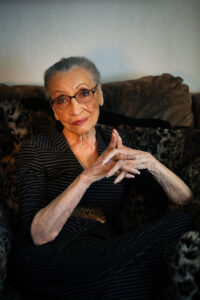
That, perhaps, is her greatest legacy.
Betty Reid Soskin did not just witness history. She protected it. She corrected it. She stood in the uncomfortable space between myth and truth and refused to move aside.
She showed us that it is never too late to matter. That age does not diminish relevance. That telling the truth—patiently, clearly, and without apology—is an act of love.
She leaves behind no easy replacement. People like her are not replaced. They are remembered. They are studied. They are carried forward in the stories we choose to tell and the silences we refuse to keep.
A public memorial will be announced at a later date. In lieu of flowers, her family has asked that donations be made to Betty Reid Soskin Middle School or toward completing her documentary film, Sign My Name to Freedom—a title that captures, perfectly, the work of her life.
The world feels quieter without her.
But if we listen closely—truly closely—we can still hear her voice, steady and uncompromising, reminding us that history is not finished, and truth still needs guardians.
She was one of them.
And now, that responsibility rests with us.



